Cloud Phone Farms: The Complete 2025 Guide to Mobile Automation (From Beginner to $10K/Month)
Cloud phone farms let you run 50+ virtual Android devices from your laptop, automating tasks that generate $1K-50K monthly. In this article you will learn about:
4 profitable paths:
- Content creators managing social media accounts,
- Developers testing apps,
- Gamers farming resources,
- Agencies providing business services.
Start free with emulators, scale with cloud infrastructure like GeeLark for professional operations.
The 30-day guide takes complete beginners through setup, automation, scaling, and optimization.
Real operators share how they went from zero to $10K+/month.
I. THE HOOK: YOUR UNFAIR ADVANTAGE IN THE MOBILE ECONOMY
Sarah went from struggling OnlyFans creator to $15K/month using 50 virtual phones. Tom’s app testing farm replaced his developer salary. Here’s how they discovered the mobile automation gold rush that’s quietly minting millionaires in 2025.
While you’re reading this, thousands of virtual phones are running 24/7, generating passive income for people who understood one simple truth: the mobile economy isn’t just about using phones – it’s about multiplying them. And right now, we’re experiencing a perfect storm of opportunity that won’t last forever.
The mobile automation gold rush nobody’s talking about is happening because three forces just collided: cloud computing costs dropped 40% in the last year, anti-fraud systems can’t keep up with new antidetect technology, and businesses desperately need mobile-first solutions. This creates an unprecedented window where a complete beginner can build a profitable phone farm faster than ever before.
Why 2025 is the perfect entry point goes beyond just technology. Platforms are more tolerant of automation (when done right), the tools have become plug-and-play instead of requiring coding skills, and the market demand has exploded. Social media management alone is now a $20 billion industry, and mobile app testing has grown 300% since 2023.
What separates the profitable operators from failures isn’t technical knowledge – it’s understanding the ecosystem. Failed operators treat phone farms like get-rich-quick schemes. Successful operators build sustainable systems that provide real value. They understand detection patterns, invest in quality infrastructure, and most importantly, they start small and scale intelligently.
Your roadmap from complete beginner to automation expert doesn’t require a computer science degree or thousands in startup capital. Whether you’re managing social media accounts, testing apps, farming game resources, or building an agency, the path is clearer than ever. This guide will take you from zero knowledge to running a profitable operation in 30 days.
Quick win: Before diving deep, here’s something you can try TODAY – create a free Android emulator on your computer, install any social media app, and see how different it behaves compared to your phone. This simple test will open your eyes to the possibilities of virtual devices. That “aha” moment you’re about to experience? That’s just the beginning.
II. PHONE FARMS 101: EVERYTHING YOU NEED TO KNOW BEFORE STARTING
A. What Is a Phone Farm? (For Complete Beginners)
Imagine having 50 smartphones in your pocket that never need charging, never break, and can work 24/7 without supervision. That’s a cloud phone farm – virtual Android devices running in data centers that you control from your laptop. Unlike physical phones that cost $200+ each and need constant maintenance, cloud phones cost $5-50/month and scale instantly.
Physical vs. cloud phones isn’t even a fair comparison anymore. Physical farms require space, electricity, cooling, maintenance, and manual intervention when things go wrong. Cloud farms? Click a button to add 10 phones. Click another to change their location to Tokyo. Having issues? Reset everything in seconds. The only advantage physical phones had – being “more real” – disappeared when cloud phones started perfectly mimicking device fingerprints.
How they actually work is surprisingly simple: powerful servers run multiple Android instances simultaneously, just like your computer can run multiple browser tabs. Each virtual phone has its own phone number, IP address, device ID, and behaves exactly like a physical phone. You connect through a web browser or app, controlling each phone as if you were touching its screen. The magic happens in the infrastructure layer, where sophisticated software ensures each phone appears unique to apps and platforms.
Legal? Ethical? Profitable? Let’s address the elephant in the room. Phone farms are completely legal – you’re simply using multiple devices, which billions of people do daily. The ethics depend on your use case: testing your own apps, managing client accounts with permission, or playing games within their terms of service are all legitimate. The profitability is proven: conservative operators make $1,000-3,000/month, while optimized operations generate $10,000-50,000/month consistently.
B. The 4 Money-Making Models Explained
App Testing (Developer path: $50-500/hour): Companies desperately need their apps tested across different devices, networks, and scenarios. Your farm becomes their testing lab, running automated tests that would take humans weeks to complete. One client might pay $5,000 to ensure their banking app works on 50 different Android configurations.
Social Media Management (Creator path: $5K-50K/month): Every influencer, business, and brand needs consistent social media presence across multiple platforms. Your farm manages posting schedules, engagement, and growth strategies for dozens of clients simultaneously. A single OnlyFans creator might pay $2,000/month for management across 20 platforms.
Gaming Automation (Passive path: $30-300/day): Mobile games often reward time investment more than skill. Your farm can complete daily quests, gather resources, and build accounts that sell for hundreds of dollars. Popular games like Clash of Clans or Rise of Kingdoms have accounts worth $1,000-10,000.
Business Services (Agency path: $10K-100K/month): Local businesses need reviews, SEO services, and market research. Your farm can monitor competitors, manage reputation, and gather market intelligence. A reputation management package for 10 local businesses could generate $15,000/month recurring revenue.
C. Investment Reality Check
Starting costs range from $0 to $500, and here’s the breakdown most guides won’t tell you. Free tier strategies using Android emulators on your existing computer can generate your first $1,000. That money funds your $50-200 beginner setup: a few cloud phones, basic proxies, and essential tools. Within 30 days, profits should cover scaling to $500/month in infrastructure.
Scaling costs of $500 to $5,000/month might sound scary, but at this level you’re managing 50-500 devices generating $10,000-50,000/month. The key is graduated scaling – never jump from 5 to 50 phones. Go 5, 10, 20, 35, 50, learning and optimizing at each level. This approach minimizes risk while maximizing learning.
Time to first profit varies by model but follows predictable patterns. App testing can land first clients within 7 days through freelance platforms. Social media management typically takes 14-21 days to establish and monetize. Gaming farms need 20-30 days for accounts to mature. Business services require 30 days for setup and client acquisition but offer highest long-term returns.
Risk factors include platform policy changes, account bans, and technical failures. Minimize these through diversification (multiple platforms), quality infrastructure (no free proxies), gradual scaling (organic growth patterns), and constant learning (join communities, stay updated). The biggest risk? Not starting because you’re waiting for perfect conditions.
III. CHOOSING YOUR PATH: WHICH PHONE FARM MODEL FITS YOU?
A. The Content Creator Path (OnlyFans, Instagram, TikTok)
Managing multiple accounts without bans starts with understanding that platforms track everything – IP addresses, device fingerprints, behavioral patterns, even typing speed. Success comes from making each account appear to be a unique person using a unique phone. This means different proxies, varied posting times, and natural engagement patterns for every account.
Engagement automation that looks human isn’t about blasting likes and follows. It’s about mimicking real user behavior: scrolling through feeds, watching stories completely, typing comments with typos and corrections, taking breaks for “sleep,” and gradually increasing activity. Your automation should pass the “grandmother test” – would your grandmother use Instagram this way?
Content scheduling across platforms becomes your superpower when done right. While competitors manually post to each platform, your farm schedules weeks of content in minutes. But here’s the secret: don’t post simultaneously across platforms. Stagger by 15-45 minutes, customize captions slightly, and use platform-specific features. This natural approach keeps accounts safe while maximizing reach.
Growing followers on autopilot requires understanding each platform’s algorithm. Instagram rewards consistent story views and genuine engagement. TikTok prioritizes watch time and shares. OnlyFans growth happens through strategic Reddit and Twitter funnels. Your farm creates these growth loops automatically, but success comes from testing and optimizing what works for your specific niche.
Income potential of $2K-20K/month is realistic with proper execution. Beginners managing 10-20 accounts part-time typically earn $2,000-5,000/month. Intermediate operators with 50-100 accounts and basic automation see $5,000-12,000/month. Advanced operators running 200+ accounts with full automation consistently exceed $20,000/month. The key? Start small, reinvest profits, and scale gradually.
B. The Developer Path (App Testing, QA Automation)
Setting up CI/CD pipelines transforms your phone farm into an automated testing powerhouse. Every code commit triggers your farm to install the latest build across dozens of devices, run test suites, and report results back to development teams. Jenkins, GitLab CI, or GitHub Actions integrate seamlessly with cloud phone APIs, creating a testing infrastructure that rivals enterprise solutions.
Cross-device testing matrices solve the Android fragmentation nightmare. Your farm runs tests on Android 8 through 14, different screen sizes, various manufacturers’ customizations, and multiple network conditions simultaneously. What takes manual testers weeks, your automated farm completes overnight. Clients pay premium prices for comprehensive device coverage that ensures their app works for every user.
Automated bug reporting elevates your service beyond basic testing. Your farm doesn’t just find crashes – it captures logs, screenshots, screen recordings, and device states, automatically creating detailed bug reports in Jira or GitHub Issues. Developers receive everything needed to reproduce and fix issues, making you invaluable to development teams.
Performance testing at scale reveals issues invisible in development. Your farm simulates thousands of users simultaneously, measures app response times under load, identifies memory leaks, and tests battery consumption patterns. These insights help clients optimize their apps before costly production issues arise.
Income potential of $5K-50K/month reflects the high value of quality testing. Freelance testing for small apps starts at $500-2,000/project. Ongoing contracts with development agencies range from $5,000-15,000/month. Enterprise testing contracts or building your own testing platform can generate $30,000-50,000/month. The developer path offers highest hourly rates but requires technical expertise.
C. The Gamer Path (Mobile Game Farming)
Game selection for maximum profit requires understanding game economies. Look for games with tradeable assets, strong player marketplaces, and limited daily energy systems that reward multiple accounts. Games with competitive elements where resources provide advantages generate highest returns. Avoid games with aggressive anti-bot measures until you’ve mastered detection avoidance.
Bot creation progresses from basic to advanced as your skills develop. Start with simple click recorders that repeat basic tasks. Progress to coordinate-based scripts that adapt to different screen sizes. Advanced bots use image recognition to handle dynamic content and machine learning to mimic human imperfection. The evolution from recorder to intelligent bot mirrors your journey from hobbyist to professional.
Anti-detection techniques separate profitable farmers from banned beginners. Randomize everything: click locations vary by pixels, delays fluctuate naturally, and sessions include “mistakes” like misclicks. Run accounts on different schedules, simulate bathroom breaks, and occasionally “forget” to collect rewards. The goal isn’t perfect efficiency – it’s perfect imperfection.
Multi-account management at scale requires sophisticated orchestration. Each account needs unique progression paths, different play styles, and varied social interactions. Use account templates that define personality profiles: aggressive players, casual farmers, social butterflies. This diversity makes your farm appear as a natural player population rather than synchronized bots.
- Income potential of $1K-10K/month depends on game selection and scale.
- Casual farming of 10-20 accounts generates $1,000-3,000/month.
- Serious operations with 50-100 accounts across multiple games see $3,000-7,000/month.
- Professional farms running 200+ accounts with sophisticated automation consistently exceed $10,000/month, especially when combining farming with account sales.
D. The Entrepreneur Path (Agency Services)
Local SEO domination strategies leverage phone farms to build powerful local presence. Create and verify Google My Business listings, generate local citations, and build location-specific social signals. Your farm simulates local search behavior, strengthening client rankings. One dentist might pay $2,000/month for dominant local presence across their city.
Review management systems address every business’s reputation needs. Your farm monitors review platforms, alerts clients to new reviews, and helps generate authentic positive feedback through customer outreach automation. But remember: fake reviews violate platform terms and laws. Focus on legitimate review solicitation and management, which businesses desperately need.
Social proof generation goes beyond simple numbers. Your farm creates comprehensive digital footprints: social media presence, content engagement, brand mentions, and community participation. This orchestrated approach builds authentic authority that algorithms and humans recognize. Clients pay premium prices for organic-appearing growth that converts to real business results.
Market research automation transforms your farm into a business intelligence engine. Monitor competitor pricing, track social media campaigns, analyze customer sentiment, and identify trending topics. Your farm becomes the eyes and ears of businesses that can’t afford enterprise intelligence tools. Package these insights into monthly reports worth $5,000-10,000 per client.
- Income potential of $10K-100K/month reflects the value of comprehensive business services.
- Starting agencies managing 5-10 small businesses generate $10,000-25,000/month.
- Established agencies serving 20-50 clients see $30,000-70,000/month.
- Elite operations providing full-service digital presence for premium clients consistently exceed $100,000/month.
The entrepreneur path requires business acumen but offers highest scaling potential.
IV. 🌟 THE INFRASTRUCTURE DECISION: YOUR MOST IMPORTANT CHOICE
A. Understanding Your Options (Comparison Matrix)
Your infrastructure choice determines everything: costs, capabilities, scaling potential, and ultimately, success or failure. Let’s decode each tier to help you make the perfect decision for your situation.
Free Tier: Android emulators work for testing and learning but hit limitations quickly. Emulators on your personal computer can run 3-5 instances before performance degrades. They’re perfect for proof-of-concept and generating first revenue, but lack the sophistication for serious operations. Detection risk is high, and scaling requires significant hardware investment.
Budget Tier: Basic cloud phones ($5-15/device) offer real Android instances in the cloud with decent performance. These services provide essential features like app installation and basic automation but often share IP addresses and lack advanced fingerprinting. Perfect for beginners managing 10-30 accounts who need reliable infrastructure without breaking the bank.
Professional Tier: Advanced platforms ($20-50/device) deliver enterprise-grade features that serious operators require. Unique device fingerprints, residential proxies, team collaboration, API access, and sophisticated antidetect technology justify the premium pricing. When your operation generates $5,000+/month, professional infrastructure becomes essential for stability and scale.
Enterprise Tier: Custom solutions ($50+/device) cater to operations requiring ultimate control and customization. Direct server access, custom Android builds, unlimited API calls, and dedicated support enable massive scaling. These solutions make sense when managing thousands of devices or building your own platform.
B. THE PROFESSIONAL’S CHOICE: Inside the GeeLark Ecosystem
“Why Top Agencies and Power Users Choose Cloud Android Phones Over Emulators”
When MaxGrowth Digital Agency hit the ceiling with physical phones and basic emulators, they faced a crisis. Managing 200+ client social media accounts across TikTok, Instagram, and Facebook had become a nightmare of device management, constant app crashes, and scaling limitations. Their previous solution – a mix of physical phones and Android emulators – was failing. Physical phones required constant maintenance, while emulators were easily detected and banned. Something had to change, or they’d lose everything they’d built.
Real Case Study: Digital Agency Scales from $8K to $47K/Month
The Challenge confronting MaxGrowth was multilayered. Managing 200+ client social media accounts required genuine mobile environments that apps couldn’t detect as emulators. Their team of 5 remote workers needed to access and manage accounts from different locations without physical device constraints. Previous solutions caused constant headaches: emulators triggered instant bans on sophisticated platforms, physical phones couldn’t scale efficiently, and team collaboration meant physically sharing devices or complex remote access setups.
The GeeLark Implementation revolutionized their entire operation. Unlike traditional antidetect browsers that only simulate mobile browsers, GeeLark provides actual cloud-based Android phones. Each cloud phone runs a complete Android system (versions 10, 11, 12 and 14), allowing installation and operation of native mobile apps exactly as on physical devices. This isn’t browser simulation – it’s genuine Android environments running in the cloud.
Advanced Features That Made the Difference weren’t just theoretical advantages – they transformed daily operations:
Cloud Android Phones: Each profile runs on a real Android environment in the cloud, not a browser simulation. Install any app from Play Store or APK, just like a physical phone. Access camera, microphone, and all phone features remotely. Every cloud phone has unique device fingerprints including IMEI, MAC address, Bluetooth address, and hardware specifications.
RPA Automation Templates: Pre-built templates for TikTok, Instagram, YouTube, and Facebook automate posting, liking, commenting, and following. Custom workflow builder lets you create automation without coding – snap operations together like puzzle pieces. Templates handle account warming, content scheduling, and engagement patterns that mimic human behavior.
Synchronizer Technology: Revolutionary feature that replicates actions across multiple phones simultaneously. Perform an action on one “master” phone, and all connected phones mirror it instantly. Perfect for posting the same content across multiple accounts or performing bulk operations while maintaining individual phone identities.
Team Collaboration Without Device Sharing: Role-based permissions control who accesses which accounts. Operation logs track all team member activities for security and accountability. No more sharing passwords or physical devices – each team member accesses assigned cloud phones from their own computer.
Your Own Proxy Configuration: GeeLark supports HTTP, HTTPS, and SOCKS5 proxies that you provide. Each cloud phone gets its own proxy for complete network isolation. This flexibility lets you use your preferred proxy provider while maintaining account separation.
The setup process, while different from traditional tools, proved surprisingly intuitive:
- Initial configuration took just 2 hours. The GeeLark dashboard walked them through creating their first cloud phone profiles, with comprehensive documentation for every feature.
- Cloud phone creation became systematic. Choose Android version based on needs (Android 11 for full features, Android 12 for automation focus, Android 14 for latest compatibility). Each phone automatically receives unique device identifiers.
- Proxy configuration required their own proxy service but offered complete control. They connected their existing residential or mobile proxy subscriptions, assigning different locations to match client demographics.
- App installation worked exactly like physical phones. Download apps from Play Store or sideload APKs. Apps see each cloud phone as a completely different device.
- RPA deployment replaced complex scripting with visual automation. Selected pre-made templates for each platform, customized engagement patterns, and scheduled posting times – all without writing code.
Results After 90 Days exceeded even optimistic projections:
- Account detection rate plummeted from 30% to 2% – platforms couldn’t distinguish cloud phones from physical devices
- Management time dropped from 40 hours to 8 hours weekly through RPA automation and synchronizer
- Client capacity exploded from 50 to 200 accounts without adding physical infrastructure
- Monthly revenue skyrocketed from $8,000 to $47,000 – a 487% increase
- Infrastructure costs decreased by 60% compared to maintaining physical phone farms
When GeeLark Makes Sense isn’t about convincing everyone – it’s about recognizing when you need genuine mobile environments:
✓ Managing accounts on apps that detect and ban emulators (TikTok, Instagram)
✓ Need for native app features not available in browsers (Stories, Reels, Live streaming)
✓ Team collaboration without physical device logistics
✓ Scaling beyond what physical phones can practically support
✓ Content creation requiring actual phone features (camera, microphone access)
Unique Advantages Over Alternatives:
- vs. Physical Phones: No hardware costs, maintenance, or physical space requirements. Scale instantly without buying devices.
- vs. Emulators: Genuine Android environments that apps can’t detect as emulated. Full app functionality including camera and microphone.
- vs. Browser-Based Solutions: Run actual mobile apps, not just mobile browser versions. Access app-exclusive features and functionalities.
The dashboard shows profile management at scale – 200 cloud phones organized by client, platform, and campaign. RPA workflows demonstrate how complex engagement patterns run automatically across multiple accounts. The synchronizer in action shows one operator managing 50 TikTok accounts simultaneously for a product launch.
AI-Powered Content Creation Bonus: GeeLark’s integrated AI tools transformed their content production. The image-to-video converter creates unique clips from single images in seconds. AI video editing streamlines content customization for different platforms. These tools alone saved 20+ hours weekly on content creation.
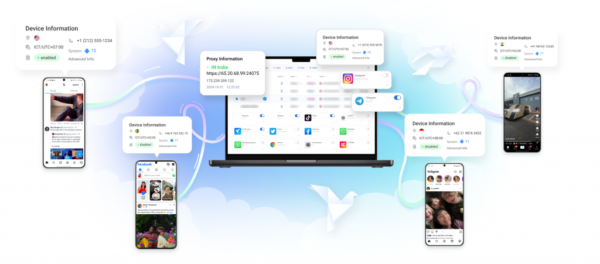
Experience cloud-based Android phones at GeeLark.com – where professional operators leverage genuine mobile environments for sustainable growth
C. Budget Alternatives Analysis
Not everyone needs or can afford premium solutions immediately. Here’s an honest assessment of alternatives:
AWS Device Farm serves developers well but lacks social media optimization. Perfect for app testing with extensive device coverage and CI/CD integration. However, the $0.17/device minute pricing becomes expensive for 24/7 operations, and social media platforms often detect and block AWS IP ranges.
Local phone arrays appeal to hobbyists who enjoy hardware projects. Building a 20-phone rack costs $2,000-4,000 initially but provides complete control. Downsides include space requirements, electricity costs ($50-200/month), cooling needs, maintenance headaches, and inability to quickly scale or change locations.
Basic cloud services balance cost and features for beginners. Services like LDPlayer Cloud or NoxPlayer offer decent automation and multiple instances. Limitations include shared IP addresses, basic fingerprinting, frequent detection, and limited API access. Perfect for learning and earning first revenue before upgrading.
Emulator setups remain viable for testing and development. BlueStacks, MEmu, and Android Studio emulators cost nothing and run on existing hardware. However, they’re easily detected by sophisticated platforms, limited by computer resources, and unsuitable for serious commercial operations.
V. BUILD YOUR FIRST FARM: 30-DAY LAUNCH PLAN
Week 1: Foundation (Beginner-Friendly)
Day 1-2: Account creation strategies set the tone for everything. Never create multiple accounts from the same IP address or device – this is the fastest path to immediate bans. Start with your personal devices and home IP for the first account. Use different email providers (Gmail, Outlook, Proton) and vary registration information slightly. Include profile photos from AI generators or stock photos, but make each unique. The “aged account” method involves creating accounts and letting them sit for 48-72 hours before any activity, significantly reducing ban risk.
Day 3-4: Free trial maximization stretches your budget while learning. Most cloud phone services offer 3-7 day trials – use different email addresses to access multiple trials across platforms. Test everything during trials: app installation speed, proxy integration, automation capabilities, and detection rates. Document what works and what doesn’t. By day 4, you’ll know exactly which paid service fits your needs and budget.
Pro tip: Some services offer extended trials if you contact support with genuine questions.
Day 5-7: First automation test brings everything together. Choose the simplest possible task – Instagram story views or game daily login rewards. Write down every step a human would take, then replicate with automation. Start with 1-hour sessions, gradually increasing to 4-6 hours. Monitor everything: battery simulation, network switching, app crashes, and unusual behavior. Your first successful 24-hour automated run without bans or crashes marks your graduation from complete beginner. Even your grandma could do this with the visual automation tools available today – no coding required.
Week 2: Scaling (Intermediate)
Proxy setup and rotation transforms amateur operations into professional ones. Free proxies are destroyers for your farm – they’re slow, unreliable, and pre-banned everywhere. Invest $30-50 in residential proxies from reputable providers. Assign one proxy per 1-3 accounts maximum. Rotate proxies every 3-7 days for social media, but keep consistent for gaming. Create a spreadsheet tracking proxy-account assignments.
Advanced technique: match proxy location to account persona (LA proxies for LA influencer accounts).
Multiple account management requires systematic organization from day one. Create naming conventions: Platform_Niche_Number (IG_Fitness_001). Maintain master spreadsheets with account details, passwords (use password manager), proxy assignments, and performance metrics. Implement the “account personality” system – each account has defined interests, posting times, and interaction patterns. This diversity makes your farm undetectable while maximizing engagement.
Basic script deployment elevates your automation beyond simple clicking. Start with platform-specific tools like Instagram automation scripts or game bot frameworks. Modify existing scripts rather than writing from scratch – GitHub has thousands of open-source options. Key modifications include randomizing delays (2-8 seconds becomes random.uniform(2, 8)), adding human imperfection (5% chance to misclick), and implementing safety stops (pause after 100 actions). For non-coders, visual scripting tools like AutoTouch or MacroDroid provide powerful automation without writing code.
Performance monitoring prevents disasters before they happen. Set up alerts for account logouts, captcha challenges, and unusual activity patterns. Use uptime monitors to track farm availability. Monitor resource usage – CPU, memory, and bandwidth consumption reveal optimization opportunities. Track key metrics: actions per hour, success rates, and ban frequency. Weekly performance reviews identify trends and improvement areas. This data-driven approach separates professionals from amateurs.
Week 3: Optimization (Advanced)
API integrations unlock your farm’s true potential. Social media platforms offer official APIs for legitimate automation – use them when possible. Connect your farm to Zapier or Make (formerly Integromat) for complex workflows. Implement webhook notifications for important events. Create custom APIs for your farm, allowing external tools to trigger actions.
Example integration: Shopify order → farm posts product review → notification to Slack. These connections transform isolated automation into comprehensive business systems.
Custom automation scripts differentiate your operation from template users. Study platform-specific behavior patterns – Instagram users double-tap photos, while TikTok users swipe. Implement progressive difficulty: simple scripts for new accounts, complex ones for established profiles. Add intelligence layers: OCR for reading text, image recognition for content understanding, and natural language processing for comments. Version control everything – when platforms update, you’ll need to quickly modify scripts.
A/B testing frameworks optimize every aspect through data. Test posting times: does 9 AM or 2 PM generate more engagement? Compare automation patterns: aggressive versus conservative growth strategies. Evaluate content types: images, videos, or carousels. Run parallel tests with control groups – 10 accounts try new strategy while 10 continue current approach. Statistical significance matters – don’t change everything based on one good day. Document findings in a testing journal that becomes your competitive advantage.
Detection avoidance patterns require constant evolution as platforms improve their systems. The “human sandwich” technique bookends automation with manual actions. “Behavioral drift” gradually changes patterns over time, mimicking real user evolution. “Social proof seeding” has accounts interact with each other, creating natural-looking networks. “Failure injection” deliberately includes mistakes – wrong buttons, canceled actions, and apparent indecision. These advanced patterns fool even sophisticated detection algorithms.
Week 4: Profit Maximization (All Levels)
Revenue optimization strategies focus on highest-return activities. Identify your most profitable accounts/games/clients and allocate more resources there. Implement tiered pricing for services – basic, premium, and enterprise packages. Bundle complementary services for higher average order values. Create recurring revenue through monthly subscriptions rather than one-time payments. The 80/20 rule applies: 20% of activities generate 80% of profit. Find and focus on that 20%.
Cost reduction techniques improve margins without sacrificing quality. Negotiate bulk proxy discounts for 100+ purchases. Use spot instances for non-critical processing. Implement automated resource scaling – reduce capacity during low-activity periods. Share resources across compatible operations. Replace expensive tools with open-source alternatives where possible. Every dollar saved equals pure profit at this stage.
Scaling decision matrix prevents premature or reckless expansion. Only scale when current capacity exceeds 80% utilization consistently. Ensure profit margins exceed 40% before adding infrastructure. Maintain 3 months operating expenses in reserve. Test new platforms/games/services with 5-10 accounts before full commitment. Document standard operating procedures before hiring help. This systematic approach ensures sustainable growth rather than chaotic expansion.
Reinvestment planning compounds your success exponentially. Allocate 40% of profits to infrastructure improvements, 30% to new opportunity testing, 20% to emergency reserves, and take 10% as personal profit initially. As operations stabilize, adjust to 25% infrastructure, 25% growth, 25% reserves, and 25% profit. Resist lifestyle inflation – your farm is a business requiring continuous investment. Today’s reinvestment becomes tomorrow’s competitive advantage.
VI. THE MONEY BREAKDOWN: REAL NUMBERS, REAL RESULTS
Startup Costs by Path
Content Creator: $50-200 makes this the most accessible entry point. Your phone already has everything needed for initial content creation. $50 covers a month of basic cloud phones (5 devices), essential proxies, and simple automation tools. The additional $150 might include premium scheduling software, better proxies, or more devices. Many creators generate first revenue before spending anything, using free trials strategically.
Developer: $200-500 reflects the need for professional testing tools. Cloud device time costs $100-200 monthly for meaningful testing. Testing frameworks and monitoring tools add $50-100. Premium IDE subscriptions and API access require another $50-100. The upper range includes specialized testing services and enterprise tool trials. However, landing just one $2,000 testing contract covers months of expenses.
Gamer: $100-300 balances automation needs with game investments. Basic bot software runs $30-50 (or free with open-source). Cloud phones for 10 accounts cost $50-100 monthly. Game purchases and in-app investments require $20-100 depending on chosen games. Proxies add another $30-50. Smart gamers start with free-to-play games, reinvesting earnings into premium games with higher returns.
Entrepreneur: $500-2000 represents serious business investment. Professional infrastructure for managing client accounts demands quality from day one – premium cloud phones ($200-500/month), reliable residential proxies ($100-200), business software subscriptions ($100-300), and initial marketing/sales costs ($100-1000). This higher investment reflects higher returns, with many agencies recovering costs within the first month.
Monthly Operating Costs
Let’s expose the real numbers nobody talks about. Your detailed breakdown at scale (50 accounts) includes cloud phones at $250-500 (depending on quality), proxies at $50-150 (residential vs. datacenter), automation software at $50-200 (custom vs. off-shelf), and miscellaneous tools at $50-100 (monitoring, analytics, management). Total: $400-950 monthly for infrastructure generating $5,000-20,000.
Hidden costs will surprise unprepared operators. Payment processing fees eat 3-5% of revenue. Account replacement costs $5-20 per banned account. Learning expenses – courses, communities, and tools – run $50-200 monthly initially. Taxes on profit can reach 15-35% depending on location and structure. Customer acquisition costs for agencies average $100-500 per client. Factor these into pricing from day one.
Ways to cut costs by 50% without sacrificing quality: Use cloud phones during peak hours only, scheduling downtime. Negotiate annual proxy packages for 40% discounts. Build custom tools replacing expensive subscriptions. Share infrastructure costs with trusted partners. Utilize free tiers strategically across multiple services. Focus on high-margin activities eliminating unprofitable work. These optimizations can reduce $1,000 monthly costs to $500 while maintaining output.
When to scale spending follows predictable patterns. Increase infrastructure when utilization exceeds 80% for two consecutive weeks. Upgrade tools when manual work exceeds 2 hours daily. Invest in premium services after consistent $3,000+ monthly profit. Hire help when opportunity cost of your time exceeds task value. Add redundancy after experiencing costly downtime. These triggers ensure spending aligns with genuine need rather than optimistic projection.
Revenue Projections
Conservative: $1,000-3,000/month represents realistic expectations for part-time operators managing 10-30 accounts. This includes social media managers with 5-10 clients paying $200-300 each, game farmers running 20 accounts generating $50-150 daily, or developers completing 2-3 testing projects monthly. These numbers assume 10-20 hours weekly investment and basic optimization.
Realistic: $3,000-10,000/month reflects dedicated operators managing 50-150 accounts efficiently. Social media agencies with 15-30 clients at $300-500 each, sophisticated game farmers with 100+ accounts across multiple games, or developers with ongoing testing contracts hit these numbers consistently. This requires 30-40 hours weekly and continuous optimization.
Aggressive: $10,000-50,000/month demands full-time commitment and advanced operations. Agencies managing 50+ clients with premium services, game farming operations with 500+ accounts and item trading, or testing companies with enterprise contracts achieve these levels. This requires team building, sophisticated automation, and business acumen beyond technical skills.
Variables affecting income include market selection (competitive vs. underserved niches), service quality (basic vs. premium offerings), operational efficiency (automation level and optimization), scale achieved (accounts, clients, or projects managed), and geographic factors (local market rates and opportunities). Understanding these variables helps set realistic goals and identify improvement opportunities.
ROI Calculator
Your simple version for beginners: Monthly Revenue – Monthly Costs = Profit. Profit ÷ Investment × 100 = ROI%. Example: $2,000 revenue – $400 costs = $1,600 profit. $1,600 ÷ $400 × 100 = 400% ROI. Most operations achieve 200-500% ROI within 90 days.
The advanced version includes all variables: factor in setup costs amortization, time value (your hourly rate), opportunity costs, tax implications, and scaling projections. Include customer lifetime value, churn rates, and seasonal variations. Calculate unit economics – profit per account/client/project. This comprehensive analysis reveals true profitability and optimization opportunities.
Break-even timeline analysis shows most operators recover initial investment within 15-45 days. Content creators typically break even fastest (15-25 days) due to low startup costs. Developers might take 25-35 days landing first clients. Gamers need 20-30 days for account maturation. Agencies require 30-45 days building client base. Understanding your break-even point maintains motivation through the challenging initial period.
VII. ADVANCED MASTERY: SECRETS OF THE TOP 1%
A. Detection Avoidance Masterclass
Fingerprint management goes far beyond IP addresses – it’s an art form the top 1% have mastered. Think of device fingerprints like human fingerprints – unique patterns that identify you. Your farm must manage dozens of identifying factors: screen resolution, installed apps, timezone, language, browser user agent, canvas fingerprinting, WebGL rendering, audio context, and hardware specifications. Professional operators use fingerprint randomization tools that generate completely unique combinations for each profile.
Here’s the technical explanation with a simple analogy: platforms create a “digital DNA” from 50+ data points. Like identical twins have different fingerprints, two phones with identical apps can have different digital fingerprints. Advanced antidetect browsers modify these fingerprints at the kernel level. They inject noise into canvas rendering, randomize audio processing, and even simulate different hardware capabilities. It’s like wearing a different digital disguise for each account.
Behavioral patterns that trigger bans follow predictable patterns once you understand platform psychology. Instant aggressive following triggers spam detection. Perfect timing (exactly every 60 seconds) screams automation. Impossible activity (liking 1000 posts without scrolling) reveals bots. Geographic impossibilities (active in New York then Tokyo 5 minutes later) raise flags. The top 1% study natural usage patterns obsessively, documenting normal user behavior ranges and staying within them.
The “warm-up” method that always works mimics how real users gradually increase platform usage. New accounts start with 5-10 minutes daily, just browsing and reading. Day 3-5 introduces minimal interaction – a few likes, maybe one comment. Week 2 begins following 5-10 accounts daily. Week 3-4 scales to normal activity levels. This patience frustrates beginners but separates professionals from banned amateurs. Think of it like athletic training – you don’t run a marathon on day one.
IP reputation management extends beyond just using proxies. The top 1% maintains IP address portfolios like investment portfolios. They track IP history, monitor blacklist status, and rotate IPs strategically. Residential proxies from reputable providers cost more but provide clean reputation. They match IP location to account persona – a Miami fitness influencer uses Miami residential IPs exclusively. Advanced operators even age IPs, using them lightly for weeks before heavy automation.
B. Scaling Without Failing
The 10-20-50-100 rule prevents the catastrophic failures that destroy promising operations. Start with 10 accounts, master them completely. Only then scale to 20, adjusting systems for new complexity. At 50 accounts, operational challenges require new tools and processes. The jump to 100 demands team building or advanced automation. Each level teaches crucial lessons. Skipping levels invites disaster – like learning to fly by jumping off a cliff.
Distributed risk strategies protect against platform changes and detection improvements. Never put all accounts on one platform, proxy provider, or automation tool.
The 33% rule maintains resilience: no single point of failure should affect over 33% of operations. If Instagram changes algorithms, you still have TikTok and Twitter. If one proxy provider fails, two others continue operating. This redundancy seems expensive until it saves your entire business overnight.
Backup and recovery systems separate professionals from hobbyists who lose everything to one ban wave. Daily account data exports preserve follower lists and content. Authentication backup ensures account recovery capability. Revenue diversification means one platform’s problems don’t destroy income. Documentation systems preserve institutional knowledge. The top 1% can rebuild operations from zero in 72 hours because they prepared for catastrophe.
When to stop scaling requires discipline most operators lack. Stop when quality degrades – engagement rates dropping indicate overextension. Stop when stress overwhelms enjoyment – burned out operators make costly mistakes. Stop when margins shrink below 30% – growth without profit is vanity. Stop when technical debt accumulates – fix systems before adding complexity. The most successful operators often run smaller, highly optimized operations rather than massive, chaotic ones.
Case studies of failures teach valuable lessons. GrowthHack Inc. scaled from 50 to 500 accounts in one month – 90% were banned within a week, destroying their reputation. FarmBot Pro ignored warming periods to accelerate growth – lost $50,000 in banned aged accounts. QuickScale Agency accepted every client without vetting – illegal activity on their infrastructure led to legal problems. These cautionary tales remind us that sustainable growth beats explosive expansion.
Success stories inspire while educating. SocialFlow started with 10 Instagram accounts, carefully scaling to 200 over 18 months, now generating $75,000/month. GameMaster began with one mobile game, mastered it completely, then expanded to 10 games with 500+ accounts producing $30,000/month. TestLab Solutions focused exclusively on React Native testing, becoming the go-to expert and commanding $500/hour rates.
These successes share common themes: patience, specialization, and systematic growth.
C. Automation That Feels Human
Random delay algorithms form the foundation of human-like automation. Humans don’t click exactly every 3 seconds – they vary between 1.5 and 8 seconds randomly. Implement Gaussian distribution for natural randomness: most actions cluster around average with occasional outliers. Add micro-delays between mouse movements and clicks. Include “thinking time” before complex actions. This randomness defeats pattern detection algorithms looking for mechanical precision.
Natural interaction patterns require studying actual human behavior. Humans scroll past content without engaging. They start typing comments then delete them. They accidentally click wrong buttons. They get distracted and leave apps open doing nothing. Your automation should include these imperfections: 70% success rate for following (missed buttons), variable scrolling speeds (fast skimming vs. careful reading), occasional app switches (checking messages), and natural session endings (gradual activity reduction).
AI-powered responses elevate engagement beyond simple templates. Use GPT models to generate contextual comments that pass human review. Train models on successful engagement patterns in your niche. Implement sentiment analysis to match response tone. Add personality consistency – each account maintains distinct writing style. However, AI isn’t perfect – include typos, emoji usage, and casual language that makes responses feel authentic rather than generated.
The “digital twin” concept represents the pinnacle of automation sophistication. Each automated account mirrors a complete human persona: consistent interests, evolving preferences, social relationships, and behavioral patterns. The fitness enthusiast account follows gym pages, likes protein shake posts, comments on workout videos, and shares transformation stories. Over time, interests evolve naturally – discovering yoga, trying new diets, or training for marathons. This complete persona development fools both algorithms and humans, creating automation indistinguishable from real users.
VIII. TROUBLESHOOTING GUIDE: FIX ANY PROBLEM
Common Issues by User Type
Content Creators face account bans and engagement drops that feel devastating but have solutions. Account bans usually result from aggressive automation or poor proxy quality. Immediate fixes include slowing automation to 30% of previous rate, upgrading to mobile proxies, and implementing proper warm-up periods. Engagement drops indicate algorithm changes or content staleness. Solutions involve analyzing competitor success patterns, refreshing content strategy, and testing new posting times. The nuclear option – starting fresh with aged accounts – sometimes beats fighting unwinnable battles.
Developers encounter API limits and testing failures that interrupt client projects. API rate limits require request pooling, caching strategies, and quota management across devices. Testing failures often stem from app updates breaking selectors – implement robust element detection using multiple identification methods. Performance issues indicate resource exhaustion – monitor memory leaks, optimize parallel execution, and implement circuit breakers. Client communication during issues maintains trust while you resolve problems.
Gamers battle detection systems and performance degradation constantly. Detection usually follows pattern recognition – inject more randomness and human imperfection. Performance issues arise from game updates or server-side changes – profile game network traffic to identify new anti-bot measures. Account bans might indicate fingerprint problems rather than behavior – verify your antidetect setup thoroughly. Sometimes switching to different games temporarily lets heat die down on problematic platforms.
Entrepreneurs manage scaling challenges and team coordination complexities. Scaling problems manifest as quality degradation – implement quality assurance checkpoints and automated monitoring. Team management issues require clear documentation, role-based access controls, and standard operating procedures. Client complaints about results indicate expectation misalignment – educate clients about realistic timelines and outcomes. Technical debt accumulation demands regular refactoring sessions – schedule maintenance windows before problems cascade.
Solutions range from simple to advanced for each issue. Simple solutions include restarting devices, clearing caches, and checking proxy status. Intermediate fixes involve script debugging, pattern analysis, and configuration optimization. Advanced solutions require reverse engineering, custom tool development, and infrastructure redesign. Start with simple solutions – they resolve 80% of problems – before diving into complex troubleshooting.
IX. FUTURE-PROOF YOUR OPERATION
Platform changes coming in 2026 will reshape the landscape. Social media platforms are implementing sophisticated behavioral analysis beyond current detection methods. Gaming companies are adopting kernel-level anti-cheat affecting virtual devices. Apple’s expansion into cloud services might provide new automation opportunities. Regulatory scrutiny around automation and data collection is increasing globally. Successful operators prepare for change rather than reacting to it.
AI integration opportunities will separate next generation operators from obsolete ones. Large language models enable truly conversational engagement automation. Computer vision advances allow sophisticated image and video content analysis. Predictive analytics optimize posting times and content selection automatically. Machine learning personalizes automation patterns for each account. Early adopters of AI tools will dominate while traditional operators struggle to compete.
Regulatory landscape evolution requires careful attention. GDPR-style privacy regulations spread globally, affecting data collection and automation. Platform terms of service become legally enforceable contracts in more jurisdictions. Tax authorities increasingly scrutinize digital income streams. Labor laws might classify some automation as employment requiring compliance. Stay informed through industry associations and legal resources to avoid costly violations.
Staying ahead of detection systems demands continuous innovation. Platforms hire teams of PhD researchers to identify automation patterns. They implement machine learning models trained on millions of bot accounts. Hardware attestation might verify physical device presence. Behavioral biometrics could identify individual users across accounts. The arms race never ends – commit to continuous learning and adaptation.
Building sustainable operations transcends technical optimization. Sustainable means profitable enough to weather storms, diversified against single points of failure, systematic enough to survive founder absence, and ethical enough to avoid legal problems. Focus on providing genuine value rather than gaming systems. Build reputation and relationships that outlast any platform. Create systems and knowledge that become your competitive moat. The most successful operators from 2020 still thrive today because they built businesses, not schemes.
X. YOUR ACTION PLAN: START TODAY
Choose Your Adventure
□ Beginner Path: Free start, test waters. Download Android emulator today. Create one account on your target platform. Spend a week learning normal usage patterns. Try basic automation with free tools. Generate first $100 to fund proper infrastructure. This zero-risk approach lets you validate ideas before investing. Perfect for cautious starters who need proof before committing.
□ Intermediate Path: Small investment, quick results. Invest $200 in quality infrastructure immediately. Start with 10 cloud phones and residential proxies. Focus on one platform and model initially. Implement proven automation strategies from communities. Target $2,000 first month revenue. This balanced approach combines reasonable investment with realistic returns. Ideal for motivated individuals ready to build serious operations.
□ Advanced Path: Professional setup, maximum ROI. Allocate $1,000-2,000 for premium infrastructure. Deploy 50+ accounts across multiple platforms. Implement sophisticated automation and antidetect systems. Build team or advanced systems for scaling. Target $10,000+ monthly within 90 days. This aggressive approach requires experience or strong technical skills but delivers highest returns. Perfect for entrepreneurs ready to build significant businesses.
Resources by Path
Scripts and templates accelerate your launch. Beginners access basic Instagram automation scripts, game bot frameworks, and account management spreadsheets. Intermediate operators receive advanced automation templates, proxy rotation scripts, and performance monitoring dashboards. Advanced users get API integration examples, custom antidetect configurations, and business operation templates. These resources save weeks of development time.
Community links provide ongoing support and learning. Reddit’s r/phonefarms shares daily tips and troubleshooting. Discord servers offer real-time help and collaboration opportunities. Telegram groups provide market insights and tool recommendations. Facebook groups connect you with potential clients and partners. Active participation in communities accelerates learning exponentially.
Recommended tools vary by path and budget. Beginners start with free Android emulators and basic automation tools. Intermediate operators invest in quality cloud phones and residential proxies. Advanced users deploy professional antidetect browsers and enterprise automation platforms. Tool selection significantly impacts success – invest in quality where it matters most.
Your 30-day checklist maintains momentum:
- Days 1-3: Setup infrastructure and create first accounts
- Days 4-7: Implement basic automation and monitoring
- Days 8-14: Scale to 10 accounts and optimize performance
- Days 15-21: Add advanced features and detection avoidance
- Days 22-28: Analyze results and identify scaling opportunities
- Days 29-30: Plan month 2 based on lessons learned
Success tracker spreadsheets quantify progress.
- Track daily: accounts created, actions completed, revenue generated, and problems encountered.
- Weekly metrics include growth rates, ban rates, and profit margins.
- Monthly analysis reveals trends and optimization opportunities.
Data-driven decisions separate successful operators from hopeful gamblers.
Final Words
Whether you’re a stay-at-home mom looking to grow your side business or a developer building the next big testing platform, your phone farm journey starts with one virtual device. The technology that seemed like science fiction five years ago is now accessible to anyone with internet access and determination.
The difference between dreamers and achievers isn’t technical knowledge or starting capital – it’s taking action. Every successful operator started exactly where you are now: curious but uncertain, excited but cautious. They succeeded not through special advantages but through persistence, learning, and gradual improvement.
Your unfair advantage in 2025 is timing. The infrastructure exists, the knowledge is available, and the market demands services. While others debate and delay, you can start building today. In 30 days, you’ll have operational experience others only read about. In 90 days, you could replace your current income. In one year, you might build something that changes your life completely.
The mobile automation revolution doesn’t care about your background, education, or current situation. It rewards action, optimization, and value creation. Your farm – whether 5 devices or 500 – represents freedom from traditional constraints and entry into the new digital economy.
Start today. Start small. Start imperfect. But start. Because while you’re reading this, someone else just deployed their first virtual phone and began their journey to financial independence. Will you join them, or will you still be reading guides a year from now, wondering “what if”?
The only difference between where you are and where you want to be is the action you take today. Your phone farm journey – and the freedom it represents – begins with a single click.
Welcome to the revolution. Your empire awaits.
Our Services
-
 Vodafone Romanian Mobile Proxy
Original price was: 85,00 $.50,00 $Current price is: 50,00 $.
Vodafone Romanian Mobile Proxy
Original price was: 85,00 $.50,00 $Current price is: 50,00 $.
-
 Orange Romanian Mobile Proxy
Original price was: 85,00 $.50,00 $Current price is: 50,00 $.
Orange Romanian Mobile Proxy
Original price was: 85,00 $.50,00 $Current price is: 50,00 $.
-
 Telekom Romanian Mobile Proxy
Original price was: 85,00 $.50,00 $Current price is: 50,00 $.
Telekom Romanian Mobile Proxy
Original price was: 85,00 $.50,00 $Current price is: 50,00 $.
-
 Reddit Aged Accounts
Original price was: 20,00 $.15,00 $Current price is: 15,00 $.
Reddit Aged Accounts
Original price was: 20,00 $.15,00 $Current price is: 15,00 $.